Phylomeny Go buy glasses.

of Deniz Cem Önduygu

Archive
Tag "biology"

This is a summary of the history of the universe, life on Earth and humanity, all belonging to the same picture shown in seven different time scales. It is in fact a reminder I made for my own use, like a summary of the course material a student prepares before an exam. (This was something I was particularly good at as a student, and I now realize that most of my personal work too is of that nature. I’ll remember this if I ever need an “artist’s statement”. If I ever become an artist.)

After publishing this, quite a lot of people have said that they want to hang a print of it on their wall. High-quality prints of different sizes and materials of The Big Picture in Seven Scales can be bought here, with worldwide shipping. (The png file you see on the web isn’t good for printing.)

The initial plan was to represent everything on one very lengthy line at one scale and produce a print to hang on some large enough wall so that the viewer can intuitively sense the amounts of time in question. For the screen medium – and for regular walls – this was not very practical so I did this version with seven scales, though I still plan to do the big version, at least 15 meters long.

My main purpose with this thing was to give a sense of how tiny our time scales are compared to the larger scheme of things, in one look. For this reason, the key feature of this visualization to me is the gray gradients relating the different scales to one another. And that’s why I stick with an oldschool flat-out one-image version instead of a fancy interactive one with zooming in and out. (It has nothing to do with my personal dislike for interaction.) By the way, I find the fact that all this immediate visual information is embedded in a 104 kilobyte image file terribly pleasing.

Dates are of course approximate. I first wanted to cite the sources for the information here but after some point of my research they became just too numerous to keep track of as I cross-checked everything in multiple sources. (When different dates were given at different sources, I chose to use something in between. Luckily there isn’t too much controversy; everybody agrees that Mayans came after the dawn of multicellular life.) In any case, I believe the information here is as public domain as can be. I will just hyperlink the sources of the linegraphs I included: the atmosphere oxygenation, the global mean temperature for 160.000 years, the world human population and the global mean temperature anomalies for 150 years.

While researching for the temperature data I had a chance to form a more informed opinion on the issue of global warming but here I won’t go into the discussions of whether it is real, human-induced or dangerous; I tried to stay as neutral as possible by showing temperature graphs at two different time scales, both accepted and used by people on both sides of the argument. If anything my visualization just says “Yes, the global mean temperature is fluctuating in every time scale, and yes, in the scale of the last 100 years we are seeing a warming trend.” – these two statements, I believe, are not debated. (This page by the University Corporation for Atmospheric Research is by far the most clear, concise and structured one I saw on the basics of global warming, and although it’s on the “warmist” side it could be a good starting point for any curious person no matter his/her inclination on this politically charged issue.)

Some of the information on The Big Picture is less conclusive than the majority and perhaps I should add a few explanations for those.

  • The RNA World hypothesis about the origin of life may be impossible to confirm but I observe that it’s the most popular one among scientists, and I was assured enough when I saw it favored in the prestigious Molecular Biology of the Cell (Fifth Edition).
  • The dates for the beginning of sexual reproduction are also vague, and I have nothing to say about that. I just wanted to give you a piece of advice based upon my experience: don’t ever google “sex” if you want information on the evolution of sexual reproduction. Just don’t. The world doesn’t work like that.
  • There’s some recent findings, published in Nature in 2010, that suggests that multicellular life may have begun as early as 2.1 billion years ago but I chose to stick with the status quo on that because the paper’s too fresh.
  • There’s also some new findings (Science, 2005) suggesting, contrary to what we knew, that grasses may have evolved before the end of dinosaurs. (Just a cool way of saying “They found grass in fossilized dinosaur dung”.) Here I was convinced enough to have it their way.
  • There are people who claim that the Moon landing was faked. There are also people who claim that everything popped into existence 6000 years ago. Just so you know.

One terminology note: The dinosaurs – that are extinct – are dubbed “non-avian dinosaurs” today by scientists because we’re sure that birds are technically dinosaurs too. So we mustn’t say that “dinosaurs”, in their entirety, are extinct. However, as Jack Horner reminds us, all the kids in the world know that birds are not really cool enough to be dinosaurs.

Please don’t hesitate to contact me via comments below or email if you think there are corrections to be made, very important things to add, etc. I’m sure it’ll need updating in future, thus the “v1.2″ in the title.

My thanks go to Bilge Kobaş, Amaç Herdağdelen and Eser Aygün for their useful and challenging comments, as always. Eser has suggested that I should also add the future of the universe and at first I loved the idea. However, when I did research for the future scenarios for humanity, the Earth and the universe, I realized that there are too many alternatives – nearly all of them speculative – and it would be misleading if I chose between them and omit the rest. The historical information displayed in this work is obviously much more conclusive compared to our predictions about the future, and adding those predictions here would unfairly diminish the reliability of the former. Maybe I can do another version just for the alternative future scenarios. In future. That’s one scenario.

I dedicate this piece to mom, who has made sure, recently and on many past occasions, that I stayed sane enough to be spending time on these things.

Biology as Ideology: The Doctrine of DNABiology as Ideology: The Doctrine of DNA by Richard C. Lewontin
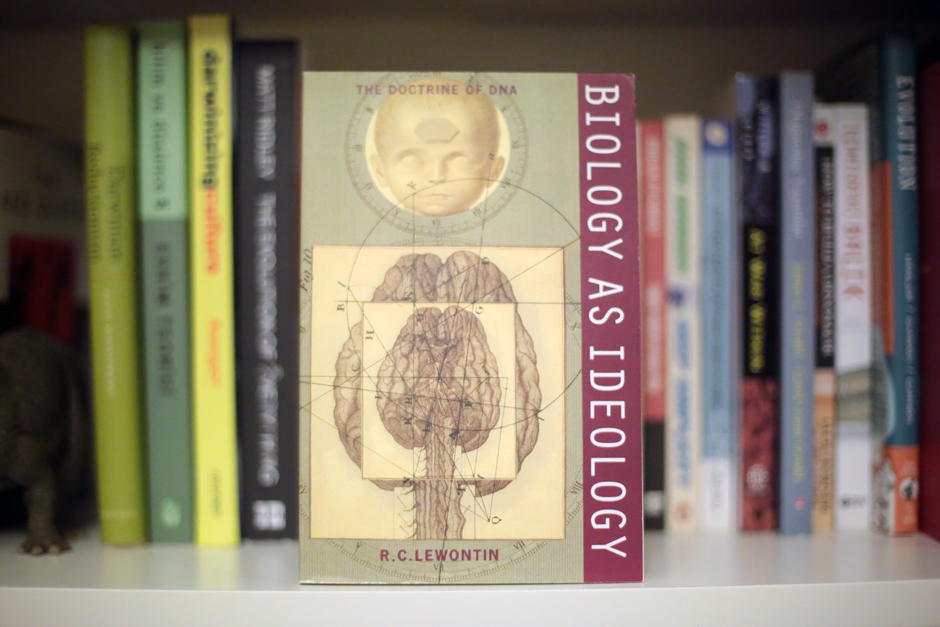
Lewontin is a leftist and he couldn’t be more obvious about it. When he unconvincingly accuses all science of being ideological, it seems like he’s preparing the ground for and justifying the strong ideology behind his own writing. He refuses the extreme idea that genes are the source of all causation in the human sphere, only to replace them with bourgeoisie and capitalism! Yes, he takes particular delight in linking everything from reductionism as a scientific tool to the information-theoretical paradigm in biology back to “the bourgeois revolutions of the eighteenth century”. It’s funny how reductionistic leftists can become when trying to refute reductionism.

It’s one thing to dream of a more egalitarian, more democratic and more fair society; it’s another to filter facts according to that dream. I find this confusion especially troubling for a scientist: everything he writes suggests that if ever science shows beyond dispute that intelligence – or some other “good” human quality – is differentially inherited, he will reject that conclusion just because it’s not in line with his precious ideals of equality and fairness. (He actually has a go at it in the book, and maybe this isn’t much of a problem for him since he admits that scientists are inevitably ideological creatures.)

Speaking of fairness, I actually loved the book (1) because it is nicely designed and (2) because Lewontin certainly has a rare gift of balancing our thinking against the sometimes lazy Dawkins-Dennett line of thought by pointing out neglected perspectives and offering a lot of food for thought. The problem is that – just like his ally Gould – often he’s pushing it too far, to the point that the poor arguments injected at those specific points compromise his otherwise amazing authorship.

Another problem worth noting is that in some of the corrections he proposes for the Dawkinsian reductionism – again, just like Gould – he is actually overlapping with what Dawkins says, only with a different vocabulary: the contructionism (“the environment of organisms is coded in their DNA” – p.112) that he defends against adaptationism is the same as Dawkins’s concept of extended phenotype (1982), and the below passage with which he closes the book (1991) is one step shy of memetics (1976).

(…) the genes, in making possible the development of human consciousness, have surrendered their power both to determine the individual and its environment. They have been replaced by an entirely new level of causation, that of social interaction with its own laws and its own nature that can be understood and explored only through that unique form of experience, social action.

In this respect, he reminds me of Dennett’s metaphor for Gould in Darwin’s Dangerous Idea: the boy who cried wolf.

I’ve recently found the microscope that I had when I was a kid. In a rush of excitement, I cleaned it up, created slides by breaking a transparent plastic chocolate box, collected my specimens and took photos by just holding the camera lens up to the eyepiece. Enjoy. (The images below are 200–400×.)

Red blood cells, Homo sapiens (Me) – The cells are the small red things (6–8 μm), the big thing containing them is not a cell, it's a drop of blood.


This is my dear antique microscope; metal body, made by the Soviet Russian company OПTA, model УМ-401П-1 No9206. I remember that my father had bought it at a flea market.

Toilet paper. Yes, it looks disgusting but it's only fair, considering its use. They may make it look nice to the human eye, with hearts and flowers on it but what you see here is much more honest. If there's one thing in the universe that has the right not to be beautiful on the inside, it's toilet paper. You just got to excuse it for that.

Saliva, Homo sapiens (Me again. I don't remember eating something like that though.) – You can see the transparent epithelial cells damaged by the toothpick I used to get them on the slide. Again, I seriously don't know what that thing in the middle is.

Needle tip

White grape skin, Vitis vinifera – Cell membranes and chloroplasts (green little things, 5 μm) are visible.

Foot, Musca domestica – I was on the lookout for houseflies once I found the microscope. I got lucky the day after. At least I thought so, until I saw this. Definitely not the prettiest foot I've seen. I mean, it has ugly feet even for a fly. I bet there are decent flies out there with much nicer feet than this. In fact I declare this to be my research agenda for the next three years.

Now that I’ve recollected the old joy of playing the biologist, I started looking for a new professional (compound) microscope to buy – not for research, obviously, but to see/photograph things like these. I’ll be happy to listen if you have any suggestions.

Dawkins vs Gould: Survival of the FittestDawkins vs Gould: Survival of the Fittest by Kim Sterelny

I had low expectations for this book because of its (typographically) cheesy cover design and clumsy typesetting. In the end it made me want to read his other books.

The author uses the debate between Dawkins and Gould to walk through many important topics in evolutionary biology, mentioning lots of other scientists and philosophers on the way, and successfully switching between detailed examples and the big picture. He definitely knows what he’s talking about, and his writing is so clear and concise that it somehow resonates with the in-your-face 12-point Baskerville it’s set with. Even so, I would recommend it to those who have read Dawkins/Gould and are somewhat familiar with their ideas. The book ends with an amazing Suggested Reading section where Sterelny makes useful comments on every book he suggests.

In any case, Kim, if you’re reading this: change your publisher. Your book deserves better design.

And this is something I did (based on the original) reflecting where I stand on the debate:

Freedom and Neurobiology: Reflections on Free Will, Language, and Political Power (Columbia Themes in Philosophy)Freedom and Neurobiology: Reflections on Free Will, Language, and Political Power by John R. Searle

Searle is always good at summarizing things, and the introduction entitled “Philosophy and the Basic Facts” offers a nice big-picture, including my favorite part of the book: a list of recent (last century) – and fortunate, in my opinion – changes in philosophy:

  1. Epistemology is no longer at the center of philosophy.
  2. Philosophy of language is no longer at the center of philosophy.
  3. Systematic large-scale philosophy is possible again.
  4. There is now no sharp distinction between philosophy and other disciplines.

The chapter on free will, however, comes along very dry as we witness the classic Searle reasoning through nothing but plain common sense and dismissing fruitful (and possibly accurate) ideas/theories on the basis that they are “intellectually very unsatisfying” (p. 62), or “literally incredible” (p. 77).

The most obvious and even fun case is on pages 45–46 where he literally uses his nemesis Dennett’s heterophenomenology approach (“Granted that we have the experience of freedom, is that experience valid or is it illusory?”), only to discard the illusion answer as it is “absolutely astounding”. One wonders how many more counter-intuitive facts we have to discover in order for him to abandon his intuitions; apparently the Copernican, Darwinian and Einsteinian revolutions weren’t enough.

In the end Searle declares that there are two viable answers to the question of free will: epiphenomenalism (i.e. free will in its ordinary sense is an illusion) and quantum indeterminism. For the latter, he bypasses the common criticism (“randomness isn’t freedom”) by proposing that randomness at the micro level may not necessarily imply randomness at the macro level. Yes, enter the almighty emergence…

For a book with a such promising title, it is hugely disappointing to find out that the two chapters “Free Will as a Problem in Neurobiology” and “Social Ontology and Political Power” were written separately and only relate to each other as parts of a “much larger philosophical enterprise”. Nevertheless, the second chapter has proved useful to me with the concept of “desire-independent reasons for action”, getting close to answering a question pending in my mind for years: What motivates a rational person to vote in elections while she knows that her single vote isn’t going to change anything?

I must confess that, despite all its disappointments, I realize that I still like the book. I fear it may be because it has a marvelous cover.